

Tour players trust the same numbers.
Accuracy depends entirely on the tracking hardware. At the top end, TrackMan, which we run in one of our three bays, is the same technology used on the professional tours, at televised events and by club fitters worldwide. When a tour player checks their carry distances, these are the numbers they trust. Our other two bays run ProTee VX launch monitors, which read the club and the ball the same way, so every bay gives you full ball and club data on every shot. A phone-app simulator and a launch-monitor bay are not the same product.
Genuinely accurate is not the same as perfect. Every system has a margin, and one odd reading in twenty is not a swing fault. Look at the pattern across a set of shots rather than agonising over a single line on the screen.
How the tracking actually works.
Measured, not guessed
The TrackMan iO tracks the club and the ball directly using Doppler radar paired with a high-speed camera. The ProTee VX does the same job with twin high-speed cameras. Both measure what the club and ball actually did through impact. Neither infers your shot from the swing alone.
Indoors, flight is modelled from measurement
In a bay, the ball flies a few metres before the screen. The system measures launch speed, angles and spin in that window, then computes the full flight from those physics, the same method used for fittings, where the resulting distances have to be right.
Real balls, your clubs
You hit standard golf balls with your own clubs (or ours; club hire is at the venue). No foam balls, no sensors taped to your glove, nothing that changes how the shot feels.
The numbers on your screen.
Every shot in every bay reports ball numbers (ball speed, launch angle, spin rate, carry and total) and club numbers (club speed, smash factor, attack angle, club path, face angle and face to path). The ball numbers say where it went. The club numbers say why. That's the difference between practising and improving. New to the jargon? Our guide to what your golf simulator numbers mean goes through each one in plain English, and we're happy to talk you through your data on the day.
For improvers
Real carry distances for every club in the bag. Hit six or seven balls with each, write down the average, and you'll probably find your "150 club" carries 137. Knowing your true numbers changes how you play approach shots forever.
For course play
The same measured physics drives full rounds on over 2000 full-size courses, so the 7-iron you flush on the simulator behaves like the one you flush outdoors. See how that compares to mat-and-guess practice in our simulator vs driving range guide, or pick a bay with the TrackMan vs GSPro guide.
For complete beginners
Accuracy isn't just for low handicaps. The instant feedback is what makes learning fast. You see the effect of every change immediately, in numbers and ball flight, with no one watching from the next mat.
What every bay reads on each swing.
| Metric | What it tells you |
|---|---|
| Club speed | How fast the club head is moving at impact. Your power source. |
| Ball speed | How fast the ball leaves the face, and the biggest driver of distance. |
| Smash factor | Ball speed ÷ club speed: how much of your swing reached the ball. About 1.50 is the driver ceiling. |
| Launch angle | The vertical angle the ball starts on. Too low or high costs carry. |
| Spin rate | Backspin in rpm. Too much and the ball balloons and drops short; too little and it falls out of the air. |
| Attack angle | Up or down on the ball at impact. Key to launch and compression. |
| Club path | The direction the head is travelling through impact. The ball curves away from it. |
| Face angle | Where the face points at impact. The ball starts roughly where the face points. |
| Face to path | The gap between the two above, and the number that actually predicts the curve. |
| Carry distance | How far the ball flies before landing: your true yardage per club. |
Carry: the one to learn first.
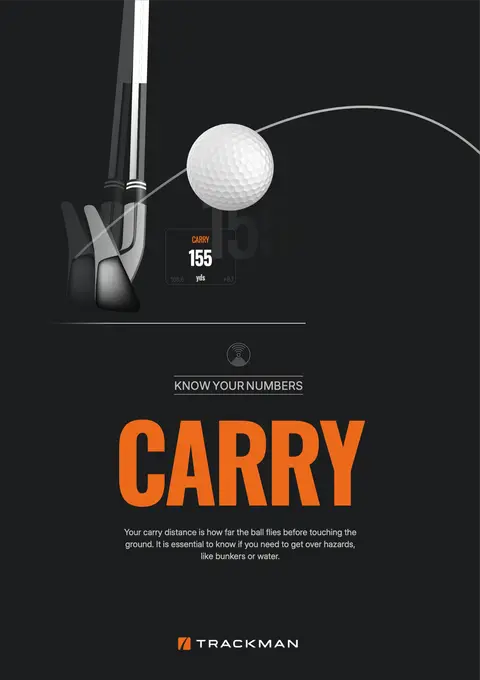
Carry distance is how far the ball flies before touching the ground, which matters when you need to clear a bunker or water, and the honest measure of each club in your bag. Every bay reports it on every single shot, to the yard. Most people quote their total and then come up short all summer.
Poster from TrackMan's "Know Your Numbers" series, the same readouts you'll see on screen in our TrackMan bay at Virtual Fairways.
See your real numbers.
Book a bay in Darlington from £27/hour and find out what your shots are actually doing. Want the TrackMan bay? Say so when you book. First time? Read the first-visit guide for 10% off.
Book a bay View Pricing Message on Facebook
 Message on Instagram